How Much Yarn Do You Need for a Blanket? A Swatch-Based Estimate
For a flat rectangular blanket, estimate yarn by dividing the planned blanket area by the area of a representative swatch, then multiplying by the yarn used in that swatch. Add a separate planning allowance and divide by the length on your yarn label to estimate whole skeins. The answer depends on your measurements; a blanket size alone cannot determine a reliable shopping quantity. Use the blanket calculator for an editable size-and-swatch worksheet.
Measure the fabric you actually plan to make
Make a sample using your intended yarn, stitch pattern, hook or needles, and working tension. Follow the pattern and yarn care instructions for any finishing before recording its dimensions. The Craft Yarn Council's gauge guidance recommends swatching with the specified materials and stitch pattern before starting a project.
For a consumption estimate, record both the sample's area and the yarn length used to make that same area. Do not measure the center of a larger sample and pair that smaller area with the yarn used by the entire sample: that would inflate the estimate. Keep a note of whether tails are included. If substantial tails or sample-only edges are included, the area calculation would multiply those extras as though they occurred throughout the blanket.
You need five measurements: blanket width and length, swatch width and length, and swatch yarn consumption. Use one unit for all four dimensions. Use yards for both yarn consumption and label length, or meters for both. If a swatch is not representative of the planned fabric, improve the measurement before relying on the result.
Work through a hypothetical 50 by 60 inch example
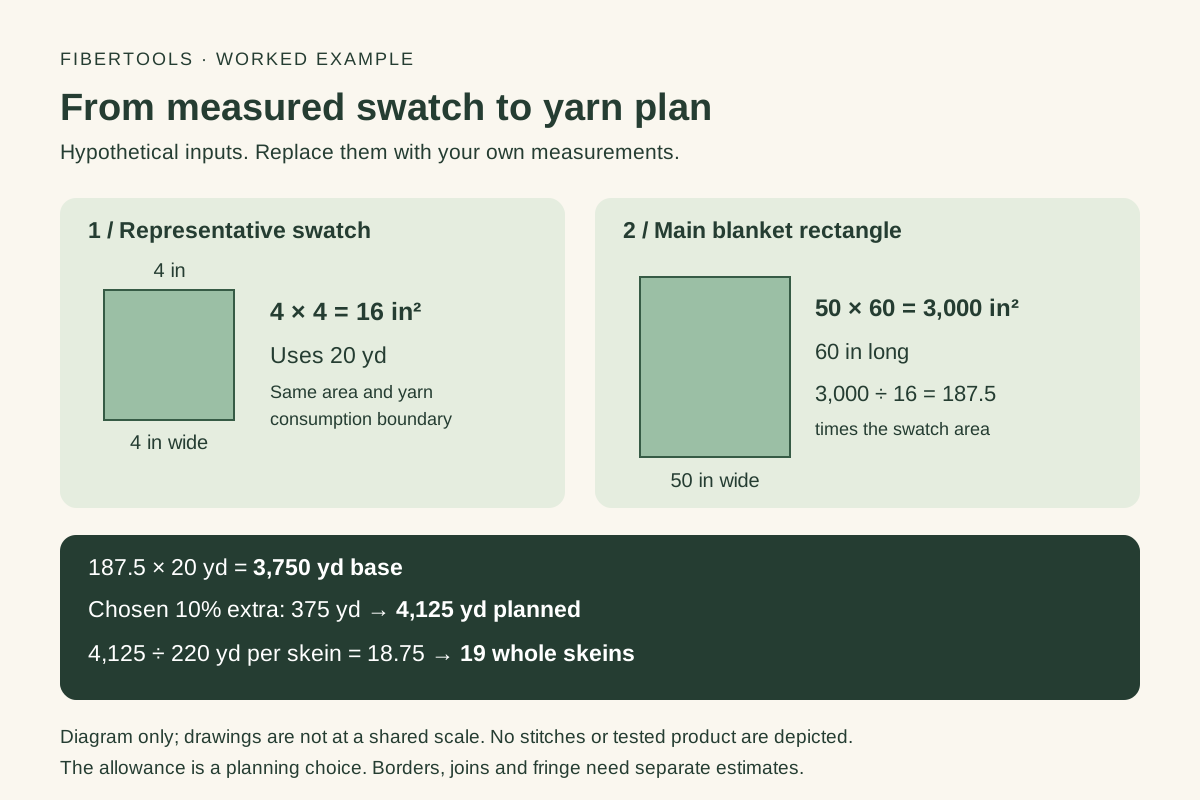
Suppose the blanket's main rectangle will measure 50 by 60 inches. Suppose a representative 4 by 4 inch sample uses 20 yards. These are illustrative inputs, not measurements from a blanket we made or a universal estimate for a throw.
| Step | Calculation | Result |
|---|---|---|
| Main blanket area | 50 × 60 | 3,000 square inches |
| Sample area | 4 × 4 | 16 square inches |
| Area ratio | 3,000 ÷ 16 | 187.5 |
| Base yarn estimate | 187.5 × 20 yards | 3,750 yards |
| Chosen extra allowance | 3,750 × 0.10 | 375 yards |
| Planned yarn total | 3,750 + 375 | 4,125 yards |
The 10 percent allowance is a choice for this example, not a tested waste rate or a promise that it covers your project. In the FiberTools yarn calculator, enter these dimensions, 20 yards of sample consumption, and an allowance of 10 to reproduce the planned total. The calculator shows the allowance separately from its measured-input base.
Convert the total into skeins without rounding down
If your chosen yarn label lists 220 yards per skein, divide 4,125 by 220. That is 18.75 skeins, so the whole-skein plan is 19 skeins.
Check the rounding against the actual lengths: 18 skeins contain 3,960 labeled yards, which is 165 yards short of this plan. Nineteen contain 4,180 labeled yards, which is 55 yards above it. That final 55 yards comes from buying whole skeins; it is separate from the earlier 375-yard allowance.
Before buying, check the seller's current return policy; do not assume unused skeins can be returned. Use your own label values. The 220-yard value is hypothetical and does not identify a product. To use the calculator's “Yarn length + skeins” option, also enter the actual weight per skein: that field supports the displayed purchase weight, rather than changing the area-based yarn requirement.
Keep borders and other construction separate
The main-rectangle estimate does not calculate a border, fringe, joining method, or a shaped design. Adding border width to the rectangle while using a swatch of a different body stitch would assume both fabrics consume yarn at the same rate. That assumption may not fit your plan.
Use construction-specific pattern quantities or a separate representative sample for those parts. Record their requirements explicitly. If you add them separately, make clear what your percentage allowance still covers so you do not accidentally count the same extra twice. Decide whether swatch yarn will be reused or needs its own allocation.
For multiple colors, plan each color's requirement separately before rounding to skeins. A combined total cannot tell you how many skeins of each color to buy.
Check how sensitive the estimate is
Holding this example's dimensions constant, a sample measurement of 19 yards instead of 20 gives 3,562.5 base yards. At the same 10 percent allowance, that becomes 3,918.75 yards: 18 whole skeins at 220 yards each. A measurement of 21 yards gives 4,331.25 planned yards: 20 skeins.
Those are arithmetic comparisons, not an observed error range. They show why a small change in the sample's measured consumption can change the shopping list. Record your measurements rather than treating the example's 19 skeins as a recommendation for every blanket.
Common questions
How many yards of yarn do I need for a throw blanket?
There is no fixed amount. In this hypothetical example, a 50×60-inch throw and 4×4-inch, 20-yard swatch scale to 3,750 base yards, 4,125 planned yards with a chosen 10% allowance, or 19 illustrative 220-yard skeins. Enter your own measurements in the yarn calculator.
How many yards is a throw blanket?
This usually asks how much yarn a throw needs. In this hypothetical example, a 50×60-inch throw and 4×4-inch, 20-yard swatch produce 3,750 base yards, 4,125 planned yards after a chosen 10% allowance, or 19 illustrative 220-yard skeins. Replace every input with yours in the yarn calculator.
How many yards for a throw blanket?
Use the throw's area and measured swatch, not a fixed yardage. In this hypothetical example, 50×60 inches and a 4×4-inch, 20-yard swatch produce 3,750 base yards, 4,125 planned yards after a chosen 10% allowance, or 19 illustrative 220-yard skeins. Recalculate from your own swatch in the yarn calculator.
Can I use yarn weight alone to choose a quantity?
A category such as Medium (4) is not a measurement of your blanket's yarn consumption. The Craft Yarn Council yarn-weight system provides categories and guideline gauge ranges. The category chart places those knitting, crochet, WPI, and tool-size guidelines together for comparison. For this calculation, use a representative sample and the actual yarn label rather than turning a category into a fixed yards-per-blanket number.
Can I use this method for knitting and crochet?
The arithmetic can scale a representative flat sample of either craft. It assumes the planned fabric has the same consumption per area as that sample. It does not supply a universal conversion between knitted and crocheted fabrics.
Is the result a guarantee that I will have enough yarn?
No. It is a planning result based on the measurements and allowances you entered. Changes in fabric, dimensions or construction need their own assessment. Save those assumptions with your project notes, then use the yarn calculator to recalculate when the plan changes.