How Many Stitches Should I Cast On? Gauge, Repeats and Width
Multiply your desired width by your measured stitches per inch to get a starting count. Then check the stitch pattern's repeat requirements and calculate the width of the adjusted count. A whole number that fits the repeat may produce a wider piece than you intended, so the count and the resulting width belong together.
Start with measured stitch gauge
Gauge describes stitches and rows over a measured distance. For a width calculation, use the stitch count across the swatch, not its row count. The Craft Yarn Council recommends making a gauge swatch with the yarn, tools and stitch pattern specified for the project.
Record both parts of your measurement. “18 stitches over 4 inches” means 18 ÷ 4 = 4.5 stitches per inch. It does not mean 18 stitches per inch. Use a representative swatch and follow the pattern and yarn care instructions for its finishing before relying on the measurement.
For a hypothetical target width of 10 inches at that gauge:
10 inches × 4.5 stitches per inch = 45 stitches.
This is a mathematical planning result, not a measurement from a finished project. It assumes the gauge represented by the swatch also represents the fabric being planned.
Decide how the pattern constrains the count
The FiberTools cast-on calculator accepts desired width in inches, gauge stitches, gauge span in inches, and an optional whole-number stitch multiple. With the multiple blank, it rounds to the nearest whole stitch. With a multiple entered, it rounds the raw count upward to a complete multiple.
For the 10-inch example, entering a multiple of 6 changes 45 stitches to 48. Eight groups of six fit; seven groups total only 42. Dividing the adjusted 48 by 4.5 gives a modeled width of about 10.67 inches, roughly two-thirds of an inch wider than the target.
This upward rule is a calculator planning choice. It does not mean that every knitting pattern should be rounded up. Check the actual pattern and the width you can accept before using the count.
Why you should not round twice
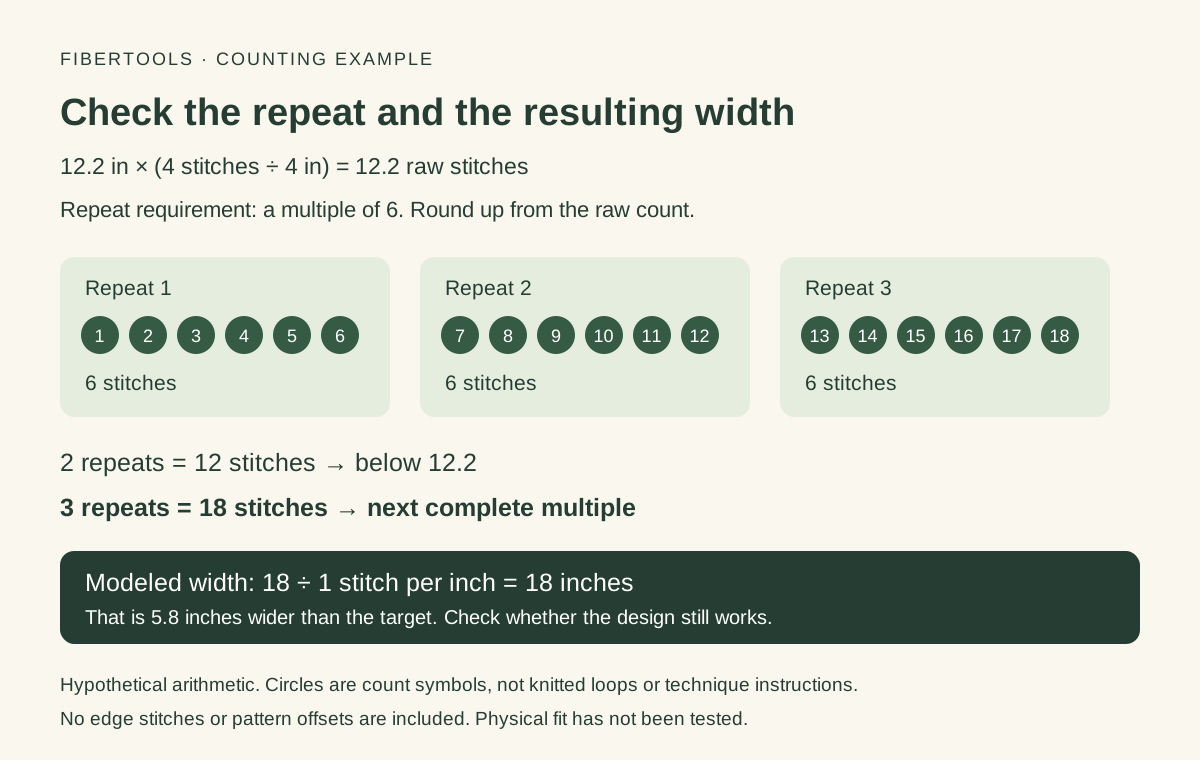
Consider a deliberately simplified example: a target width of 12.2 inches and a measured gauge of 4 stitches over 4 inches. That is one stitch per inch, so the unrounded requirement is 12.2 stitches.
If the repeat is six stitches, 12 falls below 12.2. The next complete multiple is 18. Rounding 12.2 to 12 first would discard the fraction that determines which repeat meets the upward rule.
At this example's one-stitch-per-inch gauge, 18 stitches model an 18-inch width. That is 5.8 inches wider than the target. The correct arithmetic therefore exposes a design decision: a repeat may be too large for the width you want. Do not hide that difference by reporting the count alone.
| Hypothetical inputs | Raw count | Multiple | Planned count | Modeled width |
|---|---|---|---|---|
| 10 in; 18 stitches over 4 in | 45 | None | 45 | 10 in |
| 10 in; 18 stitches over 4 in | 45 | 6 | 48 | About 10.67 in |
| 12.2 in; 4 stitches over 4 in | 12.2 | None | 12 | 12 in |
| 12.2 in; 4 stitches over 4 in | 12.2 | 6 | 18 | 18 in |
A multiple is not the same as “multiple plus”
A hypothetical instruction such as “multiple of 6 plus 2” describes totals of the form 6n + 2, where n is the number of repeats. Its extra two stitches are not part of a pure multiple of six.
The cast-on calculator's multiple field does not automatically add that offset or any edge stitches. For example, a pattern-defined total of three six-stitch repeats plus two is 20 stitches, not 18. This only explains the notation; it is not a recommendation to use three repeats for a particular garment.
Read the full pattern to determine whether its offset already includes the edges. Do not add a second pair of edge stitches simply because another example uses them. If different parts of the edge and body behave differently, dividing the entire count by body gauge remains only an approximation.
Check the plan before casting on
Write down the target width, measured stitch gauge, repeat, any pattern-defined extras, and the resulting count. Keep the desired width separate from the modeled width so a rounding change stays visible.
For a fitted item, follow the pattern's sizing and ease instructions rather than assuming a body measurement is the finished width. This count calculation does not choose ease, a cast-on technique or an edge's stretch. Use it alongside the pattern, then recheck your working gauge.
Does a cast-on count tell me which method to use?
No. The number of stitches and the way you create them are separate decisions. Use the pattern's method instructions alongside this calculation; the arithmetic does not replace technique instructions.
Can I enter centimeters in the inch fields?
Use the units printed on the form. This calculator labels its dimensions in inches. Convert your dimensions consistently before entering them rather than mixing centimeters and inches.
Does the result guarantee the finished width?
No. The displayed width is count divided by measured stitches per inch. It assumes the planned fabric matches that gauge; it does not verify a finished object. Keep the assumptions with your project notes and revisit the count when the pattern or measurements change.
Choose the method specified by your pattern
Stitch count does not determine the cast-on method. Check whether your pattern specifies long-tail, cable, tubular, or another setup, and follow instructions for that exact variation. Make a sample edge using the planned yarn and tools before deciding whether its appearance and stretch suit the project. Do not infer those properties from a stitch-count calculation.
A method comparison should answer a separate question from the count: what setup does this pattern require, and how does your sample edge behave? Keep the method, needle size and any pattern-specific setup rows in the same notes as the count. This guide does not provide step-by-step technique instructions.